
Laser safety
Workshop safety: the essentials around the laser
14 September 2026
Safety is today — thankfully — a central concern in production workshops.
Lasers are no exception. What's more, their very nature exposes technicians and operators to risks that can be insidious and unpredictable.
So let's take a broad look together at laser safety: the standards, the obligations, the recommendations and the best practices.

The different laser classes
Class 1, 0 to 1 mW: this category covers laser pointers intended for the general public. These products pose no particular danger, other than a recommendation not to look directly into the beam.
Class 2, 1 to 5 mW: this category covers powerful laser pointers, intended for construction sites or professional applications. The beams can cause damage if the user is directly exposed. In practice, accidents are rare, because the exposure time needed to damage the eyes is longer than the reaction time of the blink reflex (about 0.25 s).
Class 3, 5 to 500 mW: these lasers are mainly used in the medical field and in some professional applications. Direct exposure to the beam causes immediate and irreversible damage to the retina and surrounding structures. There is also a fire hazard, as Class 3 lasers can start combustion.
Class 4, 500 mW and above: the most powerful laser class available. The fire risk here is high due to the large concentration of energy delivered. Direct exposure to the beam causes serious, immediate eye damage at any distance. Beam reflections can also cause irreparable damage. The fire risk is at its maximum, as materials can easily catch fire if settings and processes are not mastered.
Marking and cutting with a Class 4 laser tend to release smoke and fumes. These are toxic and must be captured and treated.
Class 4 lasers are of course the most dangerous, and must be treated as a permanent potential hazard given the serious and immediate nature of the injuries they cause.
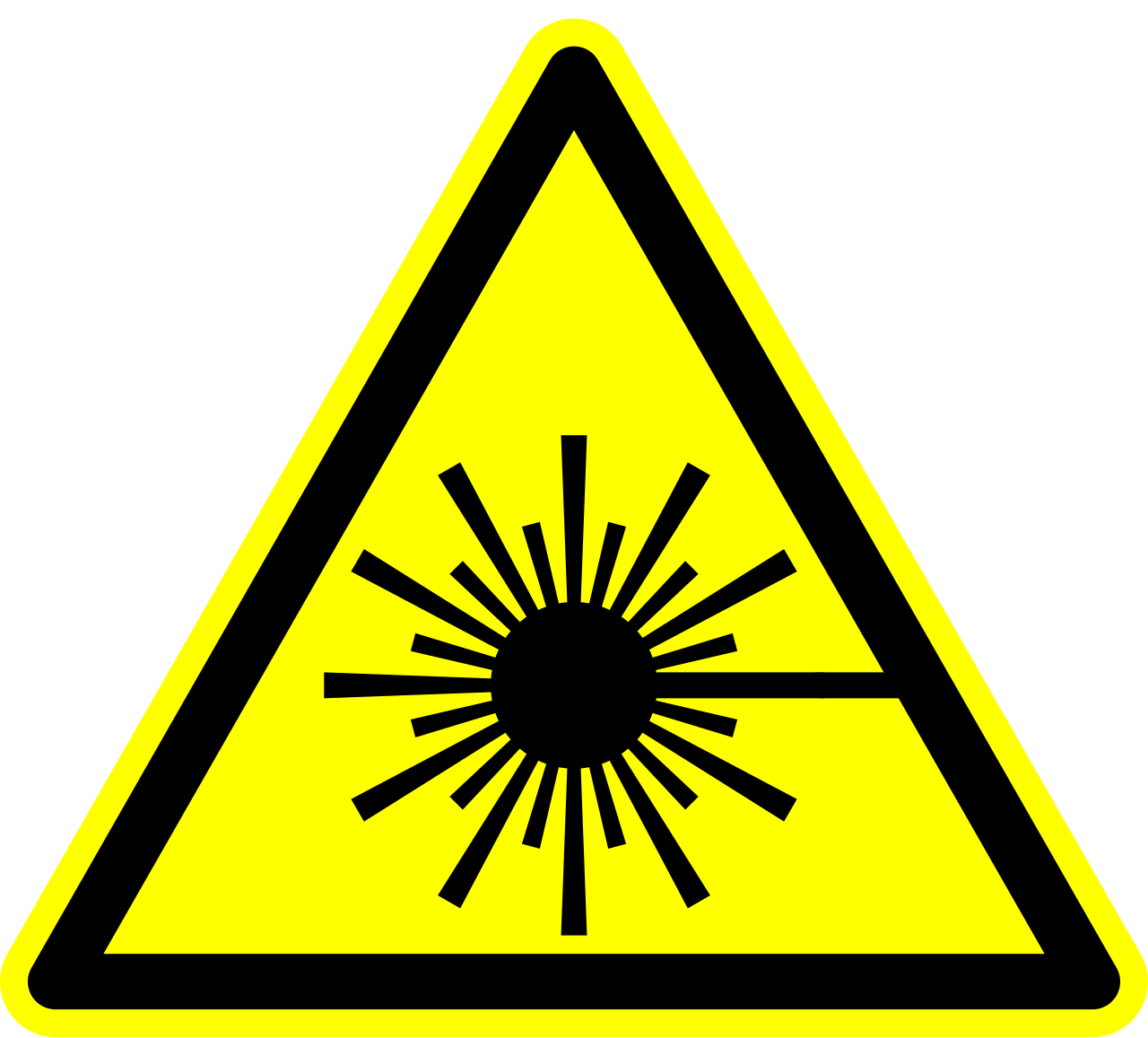
The difference between open and enclosed lasers
Thanks to their design, open and enclosed lasers are not subject to the same classification, and therefore not to the same rules of use.
The European legal framework considers enclosed lasers as Class 1, i.e. harmless to the user. They must nonetheless meet certain requirements:
- the containment enclosure must be impervious to radiation;
- the operator must be protected by an automatic machine stop when the enclosure is opened;
- appropriate signage must of course be present.
It should be noted that, even though the direct dangers to the operator are removed, the risks of fire and smoke inhalation remain very real and must be taken into account during operation.
Regulations
Here we focus on Class 4 lasers, as they include the OL Series and OL3D Series machines. Moreover, as mentioned above, the SCL and BCL Series are considered Class 1, i.e. harmless to the user.
Mandatory PPE:
- protective goggles: they must be EN 207/208 certified. Prefer goggles with side shields to limit the risk of exposure to reflections. Also make sure to choose goggles suited to the wavelength of the laser used;
- fire-resistant gloves: if an operator must place their hands in the engraving area, they must be equipped with fire-resistant gloves, made of fibre or animal leather.
The environment / certifications:
- every operator with access to the laser must obtain the PERL qualification (laser safety resource person). This training is usually delivered in one day for a few hundred euros;
- every user company must have on its team an employee acting as laser safety officer;
- access to the laser must be controlled, machines locked and accessible only to authorised employees. Obviously, no unauthorised operator may be in the same room as the laser while it is running;
- provide an air extraction or filtration system. Depending on the material and settings, an industrial laser can produce a large amount of toxic fumes.

Recommendations
These tips apply to all lasers, whatever their class. They are common-sense recommendations, which are nonetheless worth recalling:
- keep extinguishing means near the machine. A fire caused by a bad setting or an unsuitable material can start very quickly;
- never let a laser run alone: always keep a competent person in the immediate vicinity;
- read the instructions and recommendations carefully;
- add a password to the engraving software, to prevent an external or unauthorised person from operating the laser;
- follow the power recommendations according to the materials and the operation performed;
- regularly check that the emergency stop system works properly;
- do not modify the machine yourself. Any modification will introduce additional risk, on top of voiding the warranty.

What to do in case of an accident?
The most common injuries encountered when misusing a laser are to the eyes, more precisely the retina.
These injuries are instantaneous and irreversible: there is currently no technique allowing a person struck by a laser to recover their vision. This is why prevention is so important.
In the case of a laser burn, a qualified first-aider (SST) should apply a specific burn cream, as well as a suitable greasy dressing.
If, after inhaling fumes, an operator starts to experience the following symptoms — dizziness, chest pain, nausea, difficulty breathing —, move the affected person into fresh air and call the emergency services.

Conclusion
Industrial lasers are remarkable tools with endless possibilities. The trade-off is safety management that can sometimes seem cumbersome, but is essential.
If you want to equip yourself with an engraving / marking / cutting laser, but the specific safety concepts seem complex, or you would like more information, contact us! We can guide you on the right course of action and offer an audit of your installations to guarantee maximum safety.