
Laser technology
Which lens should you choose?
24 July 2026
When using a marking laser, choosing the right lens is crucial for operations to run smoothly.
This article aims to explain the general concepts of F-Theta lenses used in laser marking. For more information, feel free to contact us.
General principle
An F-Theta lens is designed to focus a laser beam onto a flat surface.
Indeed, the beam produced by the source is not concentrated. As it exits, it has a diameter of 4 to 5 mm, depending on the source and technology used. This diameter makes it unfit for any cutting or marking operation, as the energy density is far too low.
The beam is then steered by a set of mirrors. These mirrors are driven by extremely precise actuators so as to orient it in the X/Y plane.
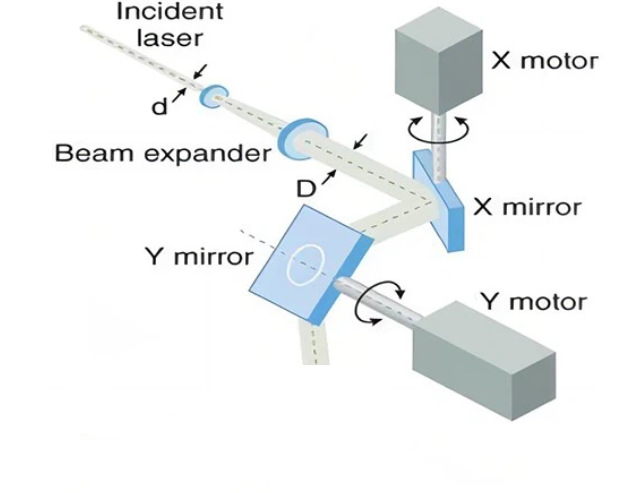
However, the now-steered beam is still not concentrated. It has the same diameter as at the source's exit. This is where the F-Theta lens comes in.
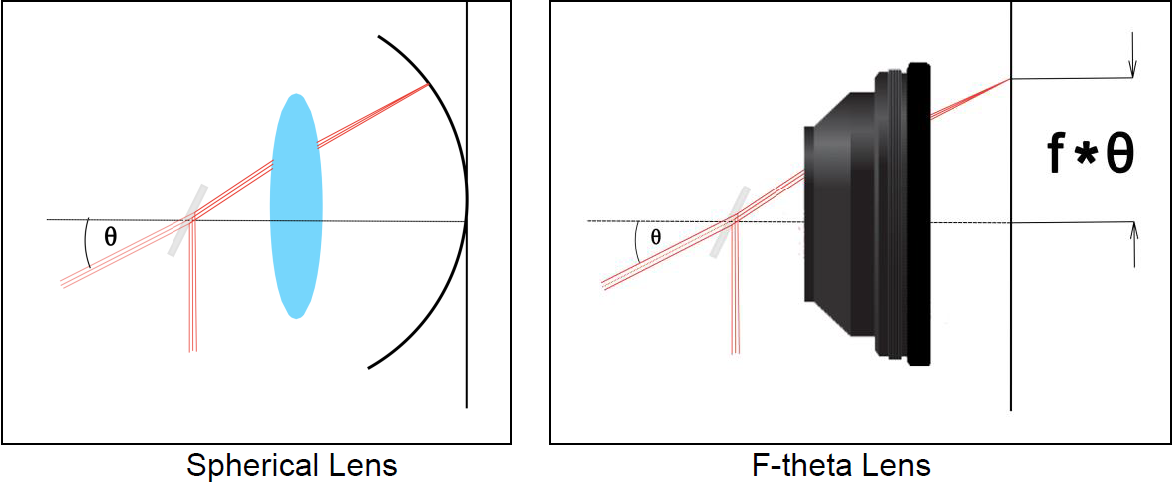
The purpose of this lens is to process the steered beam and concentrate it relative to a reference plane. It is the same principle as burning a sheet of paper with a magnifying glass and sunlight.

The particularity of F-Theta lenses lies in their ability to keep the same reference on a given surface perpendicular to the incoming beam, whatever the distance from the central point.
Thus, the laser is concentrated in the same way across the entire surface.
Technical details
An F-Theta lens has two main characteristics.
The type of material used
Each type of laser has its own specific lens type. This is due to the different emitted wavelengths. Indeed, each wavelength category has different characteristics regarding refraction, reflection and transmittance.
As the wavelengths of commercial engraving lasers range from 335 nm to 1064 nm, it is essential to use a suitable lens, cut from the right material.
The focal length
Probably the most important technical figure. The focal length is the nominal distance between the lens and the laser's point of maximum concentration. This figure is directly linked to the work area, since the maximum angle of the beam leaving the lens stays the same. Increasing the distance means increasing the work area, and vice versa.
It is important to note that the focal distance is specific to the lens and cannot be changed without replacing it.
This distance also changes the laser's characteristics at its focal point. The following formula describes the minimum laser diameter at its focal point:
d = 2fλ / D
Where d is the minimum diameter of the outgoing beam, f the focal distance of the lens, λ the beam wavelength, and D the diameter of the incoming beam.
We can extrapolate that increasing the focal distance f increases the minimum beam diameter linearly. This increase in diameter has several consequences:
- lower energy concentration: the power required increases with the focal distance;
- less precise result: for fine engraving, an unsuitable focal distance can produce a blurry or degraded result;
- for fine cutting, the increase in power and beam diameter can degrade results. Instead of vaporizing the substrate, the laser chars or melts the material.
Conclusions
Each application has its optimal lens. Here are the general recommendations:
- fine, precise engraving, QR codes, fine marking on metals, precise cuts: ≈ 150 mm;
- general engraving, cosmetic marking of plastic parts, cutting non-metallic materials: ≈ 250 mm;
- lower-precision engraving, processing bulky parts (e.g. control panels): ≈ 330 mm.
A small note: with a UV engraving laser, the minimum beam diameter is smaller, on the order of 70%, due to a shorter wavelength. This type of laser can be an attractive solution if you want to combine a large processing area with good precision.
If any other questions remain, or you are unsure about the right lens choice, our team will be glad to guide you. Contact us!